
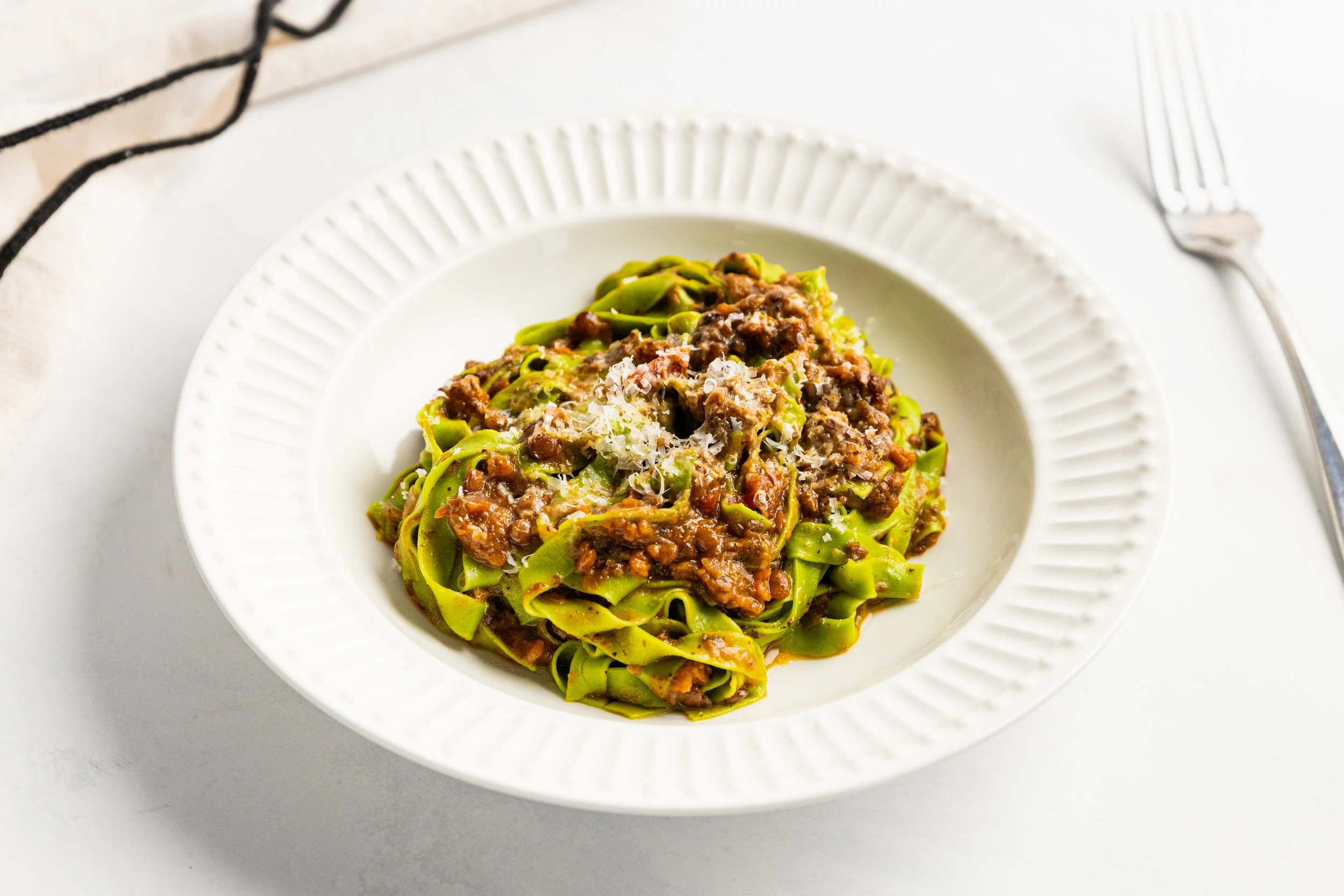
Cook Time 3 hours plus resting time
Serves 6
Ingredients
Green Pasta
100g baby spinach
20g basil leaves
60ml water
120g eggs, 2 whole eggs and 1 egg yolk
400g Tipo 00 flour
Roasted Vegetable Ragu
1 onion, cut into 6–8 wedges
2 medium celery stalks, chopped
1 whole head of garlic, cut in half, discard the skins
2 carrots, cut lengthways into quarters
½ sweet potato (roughly 300–350g), peeled and cut into thick slices
3 big mushrooms, stalks removed
3 tbsp olive oil
75g brown lentils, rinsed
80ml red wine
500ml vegetable or chicken stock
1 x 400g can whole tomatoes
2 tbsp tomato paste (concentrated purée)
1 bay leaf
1 tbsp butter, optional
To Serve
Fresh pasta for 6 (around 720g), to serve
Handful of Parmigiano Reggiano or Parmesan, grated, to serve
Method
To make the pasta, start by making your green puree. Bring a pot of salted water to a boil. Add baby spinach and basil leaves to boiling water for 20 seconds, then immediately drain and cool under cold water to prevent further cooking.
Give the leaves a good squeeze, then add to a blender or small food processor along with the water. This will help bring it together. Blitz until you have a smooth, bright green puree. Add a splash of water, if needed.
If you don't have a blender, smash the greens in a mortar and pestle to form a paste, adding water a little at a time.
Or, failing that, chop the greens as finely as possible, then run them over with a knife a few times to form a rough paste (add a splash of water if needed). This will give you a more speckled green dough.
Weigh out 120g of eggs, then reset the scales and pour in 100g of the green puree, giving you a total hydration of 220g. Whisk to combine.
Weigh out flour and place it in a bowl or on a clean work surface. Make a well in the middle of the flour and pour in the eggs and green puree. Using a fork, whisk the eggs.
Once the eggs are well whisked, slowly incorporate the flour from the top of the well, using a fork to bring in more flour as you work around the inner edge of the well, whisking well each time until you have a thick custard-like appearance.
Making sure the egg and flour are well combined at each stage will give you a lovely, even, soft dough. Repeat this circular movement a few more times until you have clumps of dough, and it becomes hard to mix with a fork. I find using a bench scraper (or dough scraper) helpful here.
Scoop up some of the flour from the outer edge and drop it in the middle. Using a chopping motion, cut the flour into the eggs. This helps combine things without getting your hands sticky. If you don't have a scraper, you can use a spatula.
Using both hands, squeeze the dough together as you turn it to continue incorporating the ingredients. Keep squeezing, turning, and slowly kneading the dough together.
Form the dough into a ball, then, using the heel of one hand, press down and push the dough forward to form an oval. Wrap your fingers around the top of the dough and then pull it back towards you.
Continue in this manner, pushing out with the heel of your hand and drawing in with your fingers. Out, in. Out, in. You'll notice that the flour continues to absorb more of the egg and that the texture begins to change. The dough will become more elastic, soft and springy.
All in all, knead the dough for 8–10 minutes. If you are finding it hard to bring it together, wrap the dough in plastic wrap (or another airtight container) and leave it to rest for 5–10 minutes. This allows the dough to rehydrate and the gluten to relax. Then knead it for a few more minutes.
The 'done' indicator is when you gently press your finger into the dough, and it springs back. It should be smooth and silky.
Form the dough back into a ball, then wrap it in plastic wrap (or an airtight container) and press it into a disc. Set aside at room temperature for 30 minutes to let the dough relax – this makes it easier to roll out by hand or through a pasta machine.
To make the ragu, preheat the oven to 190°C fan-forced. Evenly space out vegetables on a baking tray or two. Drizzle with 1 tbsp olive oil and give everything a good toss to coat. Add the veggies to the oven for 30 minutes to get a bit of colour.
Allow the roasted vegetables to cool for 5–10 minutes before blitzing in a food processor for a very finely chopped result, almost like a paste. Alternatively, mince the vegetables with a knife to make a paste.
Heat a large, deep pot with a lid over medium heat. Add the remaining olive oil and roasted veggie puree, then cook for 2 minutes. Add the lentils, stir, and cook for a further 2 minutes.
Pour in the wine, stock, tomatoes, and tomato paste, and give everything a good stir. Add the bay leaf, season, and bring the mixture to the boil. Let it simmer for a few minutes, then reduce the heat to low, cover, and cook for 2–2½ hours, stirring occasionally. The ragu should be loose, rich and full of flavour. Remove from the heat and stir in the butter, if using.
Meanwhile, bring a large saucepan of water to a lively boil and season generously with salt. Add pasta and cook until al dente, then drain, reserving 125ml of the pasta water.
Toss the pasta through the ragu along with the Parmigiano Reggiano and a splash of pasta water to loosen things up. Give everything a good toss, adding more water if needed. Serve with extra cheese.